




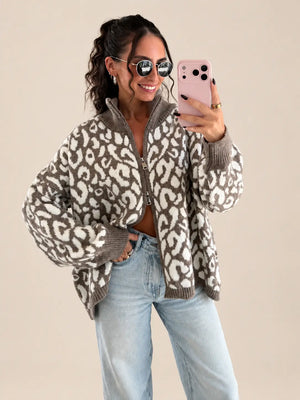
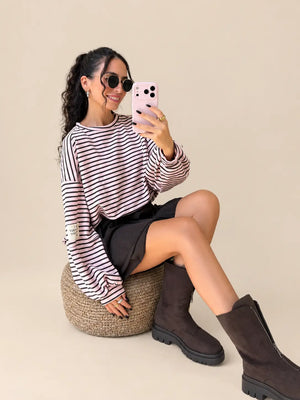
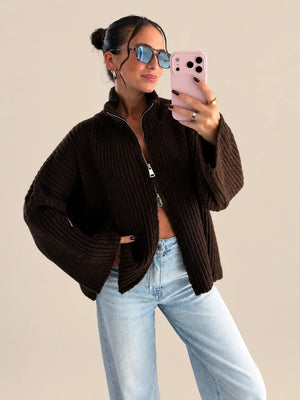
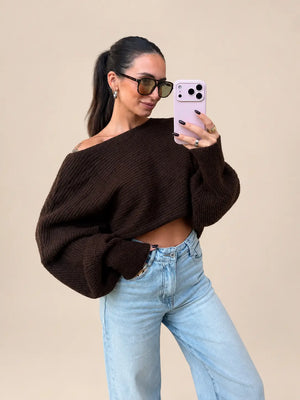


The first properly cold morning always comes as a surprise. Your winter coat is too much, a thin jumper is not enough, and the thing in between is missing from your wardrobe. Here is how to wear a checked jacket: which trousers go with it, which colours work with Brown and Bordeaux, what to put underneath, and how the check survives the wash.
What makes a checked jacket so useful in autumn
A checked jacket is neither a coat nor a top. It is the layer in between, and that is exactly why it carries the change of season so well: you pull it on in the morning, open it at noon and drape it over your arm in the evening.
The pattern does the work for you. A check brings structure on its own, so everything underneath is free to stay plain. To see what is in stock right now, have a look at the jackets.
The cut is the second reason. Wide shapes with a dropped shoulder sit loosely over a long sleeve top and still never look like loungewear.
Brown, Blue or Bordeaux — which colour goes with what
The three colours behave differently in everyday life, and that decides how much you have to put with them.
- Brown. The calmest of the three. It takes cream, beige, off white and black, and it works with almost any pair of trousers you already own.
- Bordeaux. Brings colour of its own and wants little competition. White, cream or black underneath is plenty.
- Blue. The easy route to denim, because blue on blue reads as tone on tone rather than as a break.
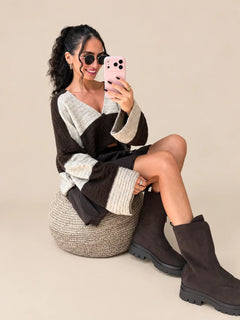
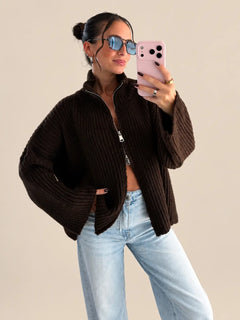
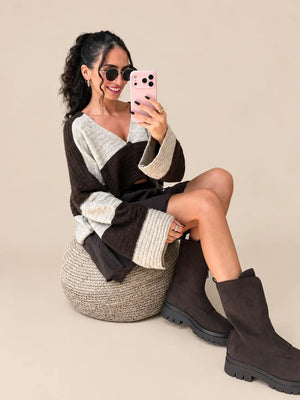
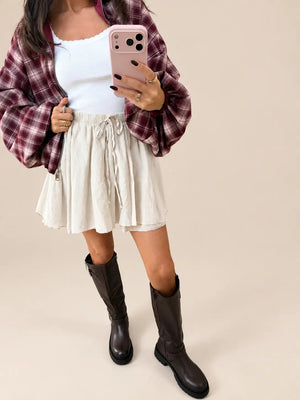
The picture above shows exactly that: the brown version over a dark bottom half, worn with tall boots. Nothing about it shouts, and the check gets the room it needs.
Which trousers go with a checked jacket
The basic rule is simple. If the jacket is wide, the trousers may well be slimmer. If you wear wide trousers, leave the jacket open at the front so a vertical line appears.
With jeans. The safe route. Straight or slightly wide jeans in mid blue or black turn the jacket into an everyday piece. Have a look at the jeans.
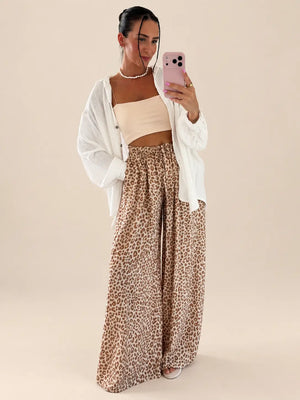
With fabric trousers. Instantly smarter. Flowing trousers in black, taupe or cream take the rustic edge off the check. Browse the fabric trousers.
With wide trousers. This works as long as top and bottom do not carry the same volume. Wear the jacket open and roll the sleeves once. The full range sits with the trousers.
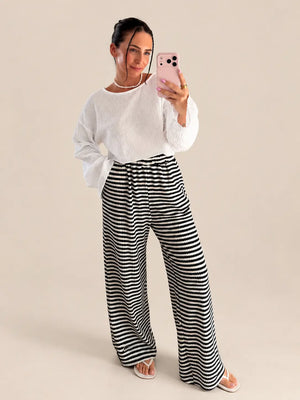
It gets tricky once your trousers carry a pattern of their own. How two patterns work side by side is covered in our guide to patterned trousers.
Shirt jacket or checked shirt — the difference in practice
On the hanger they look alike, but they wear differently. It is worth a quick look before you decide.
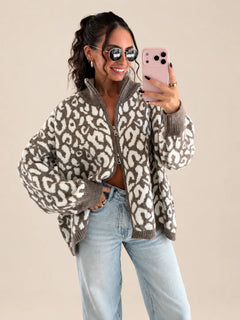
The shirt jacket is the outer layer. It is built a little more firmly, sits wider and usually stays open. In our picture it closes with a zip, and that is what makes it a jacket rather than a top.
The checked shirt does both. Buttoned up it is your top; open over a tee it becomes a light middle layer. That is exactly how the picture below is put together: buttons down the front, a chest pocket, a wide cut.
In practice that means: the shirt jacket for cool days, the shirt for mild ones. There is more on the wide cut in our post on wearing oversize well.
What to wear underneath
A check wants something quiet underneath. Anything that draws attention itself competes with the pattern, and in the end neither of them wins.
- Long sleeve top. The most unobtrusive way through the season, in black, cream or grey. You will find them with the long sleeve tops.
- Plain top. For the days that turn warm by noon. The simple pieces sit with the basics.
- Fine knit. It has to be thin, otherwise the jacket bulks up over it.
Picking up one colour from the check almost always looks right. So cream or black with the brown jacket, a clean white with Bordeaux.
Check with a second pattern
Two patterns work when they differ in scale. A bold check on top and a fine stripe below looks planned; two patterns of the same size look accidental.
A shared colour helps. If both pieces have a black or a cream in them, the eye reads them as one.
And if you are unsure, leave the second pattern out and give the second voice to your shoes or your bag instead. What has just arrived is under NEW IN.
Washing and wearing without fading the check
Checked shirts and shirt jackets are made from flannel or brushed cotton, depending on the model. Both of them like things cool and calm.
- Turn it inside out. That protects the soft surface and keeps the colours full for longer.
- Cold and on a gentle cycle. Heat shrinks cotton and bleaches the check.
- Wash it separately. Strong shades like Bordeaux tend to give off colour in the first few washes.
- Dry it in the air. Not in full sun, or the pattern fades exactly where it lies.
If you iron, use low heat and work from the inside so no shiny patches appear. Which fabric tolerates what is collected in our fabric glossary. In the end the care label in the garment is what counts.
Frequently asked questions
What is a checked jacket called?
Most often it is called a shirt jacket or an overshirt. It means a jacket cut like a wide shirt and worn as a light middle layer. When it is made from flannel, you will also hear the term lumberjack shirt.
What is a checked shirt?
A checked shirt is a shirt made from checked fabric, classically with a button placket and a shirt collar. It is worn buttoned up as a top, or open over a tee as a middle layer.
How do you wear checked shirts?
The easiest way is open over a plain long sleeve top or tee, with simple trousers. Buttoned up the shirt looks tidier and then goes better with quiet fabric trousers than with patterned ones.
Which check patterns are there?
The best known are tartan, the multicoloured Scottish check, glen check with squares of differing size, gingham with even two colour squares, and houndstooth and pepita with their broken corners. Tartan reads the boldest, glen check and pepita the finest.
What sizes is a checked jacket made for?
Our One Size models are made for sizes 34 to 42. Thanks to the wide cut and the dropped shoulder the jacket falls similarly loose across several sizes.
How do you wash a checked jacket?
Inside out, cold and on a gentle cycle, with a mild detergent and no fabric softener. Then dry it in the air rather than in the tumble dryer. What applies to your model exactly is on the care label in the garment.
More about News
Hier findest Du Styling-Ideen, Materialwissen und Pflegetipps rund um lockere Damenmode – und Links zu den passenden Kategorien im Shop.
Frequently asked questions
Worum geht es in unserem Magazin?
Um alles, was beim Anziehen hilft: Styling-Ideen für lockere Schnitte, Passform und Größen, Materialkunde und Pflege sowie Farben und Muster. Die Beiträge sind so geschrieben, dass Du sie ohne Vorwissen lesen kannst.
Wie finde ich die Teile aus einem Beitrag im Shop?
Am Ende jedes Beitrags und hier unter „Passende Kategorien“ findest Du die Kategorien zum Thema. Wenn Du ein bestimmtes Teil suchst, gib den Namen oben in die Suche ein.
Welche Beiträge helfen bei der Größenwahl?
Für lockere Schnitte gibt es einen eigenen Größenratgeber, dazu einen Beitrag darüber, was „One Size“ in der Praxis bedeutet. Die konkreten Maße stehen immer auf der jeweiligen Produktseite.
Wo finde ich Pflegehinweise zu Musselin und Strick?
Zu beiden Materialien gibt es einen eigenen Beitrag im Magazin, dazu ein Stofflexikon mit den gängigen Materialien. Das Pflegeetikett im Teil selbst gilt immer vor.
Wie lange dauert Versand und Rückgabe?
Bestellungen bis 14 Uhr gehen am selben Tag raus und sind in der Regel in 1 bis 3 Tagen bei Dir. Für die Rückgabe hast Du 14 Tage Zeit.
Which other categories are available to browse?
The linked categories offer other fashion areas to explore: New In, Bestsellers!, Women’s Tops & Blouses, Trousers & Skirts, Jackets & Knitwear, Muslin.


